Introducing Algovex AI: Build Trading Strategies With Natural Language
Introducing Algovex AI: Turn Trading Ideas Into Algorithms With Natural Language
Algovex AI is officially here.
Building an algorithmic trading strategy has traditionally required one of two things: programming knowledge or the patience to manually translate every trading rule into a visual strategy builder.
Today, we're introducing another way.
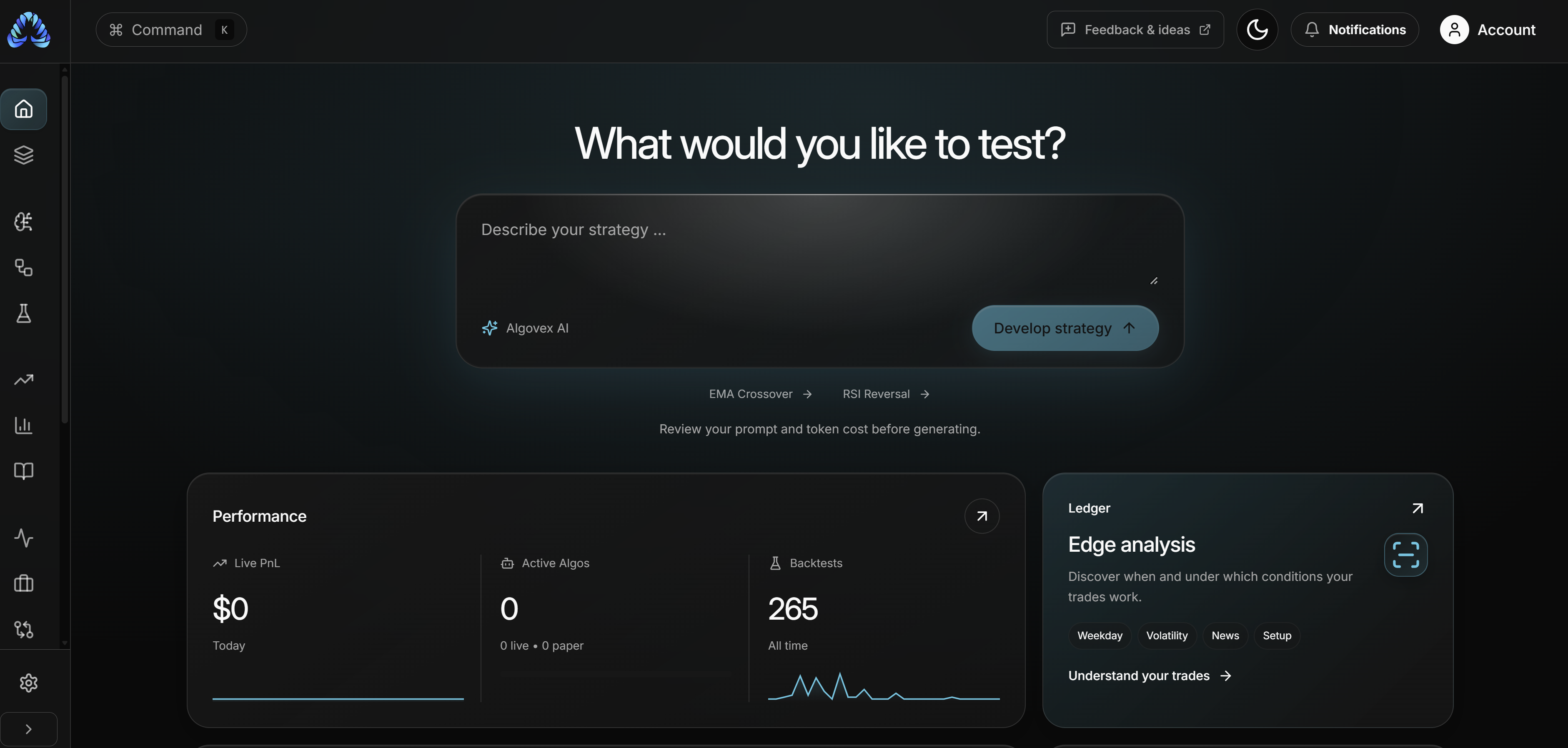
With Algovex AI, you can describe a trading strategy in natural language and turn it into an editable algorithm without writing code or manually assembling every condition.
Whether you're experimenting with a simple indicator strategy or developing a more advanced trading system, the goal is to make the process of moving from an idea to a testable strategy significantly easier.
And you can try it for free.
From Trading Idea to Algorithm
Most trading strategies begin with an idea.
Maybe you've noticed that certain markets tend to continue trending after a pullback. Maybe you want to investigate whether liquidity sweeps during the London session are followed by reversals. Or perhaps you've found a trading strategy online and want to test its claims using historical data.
The challenge is turning that idea into something a computer can evaluate.
A trading strategy needs clearly defined entry conditions, exit rules, risk management parameters, and sometimes additional filters.
Until now, Algovex users could build these strategies using the Simple Builder or the Advanced Graph, connecting visual building blocks to create the required logic.
Those tools remain available.
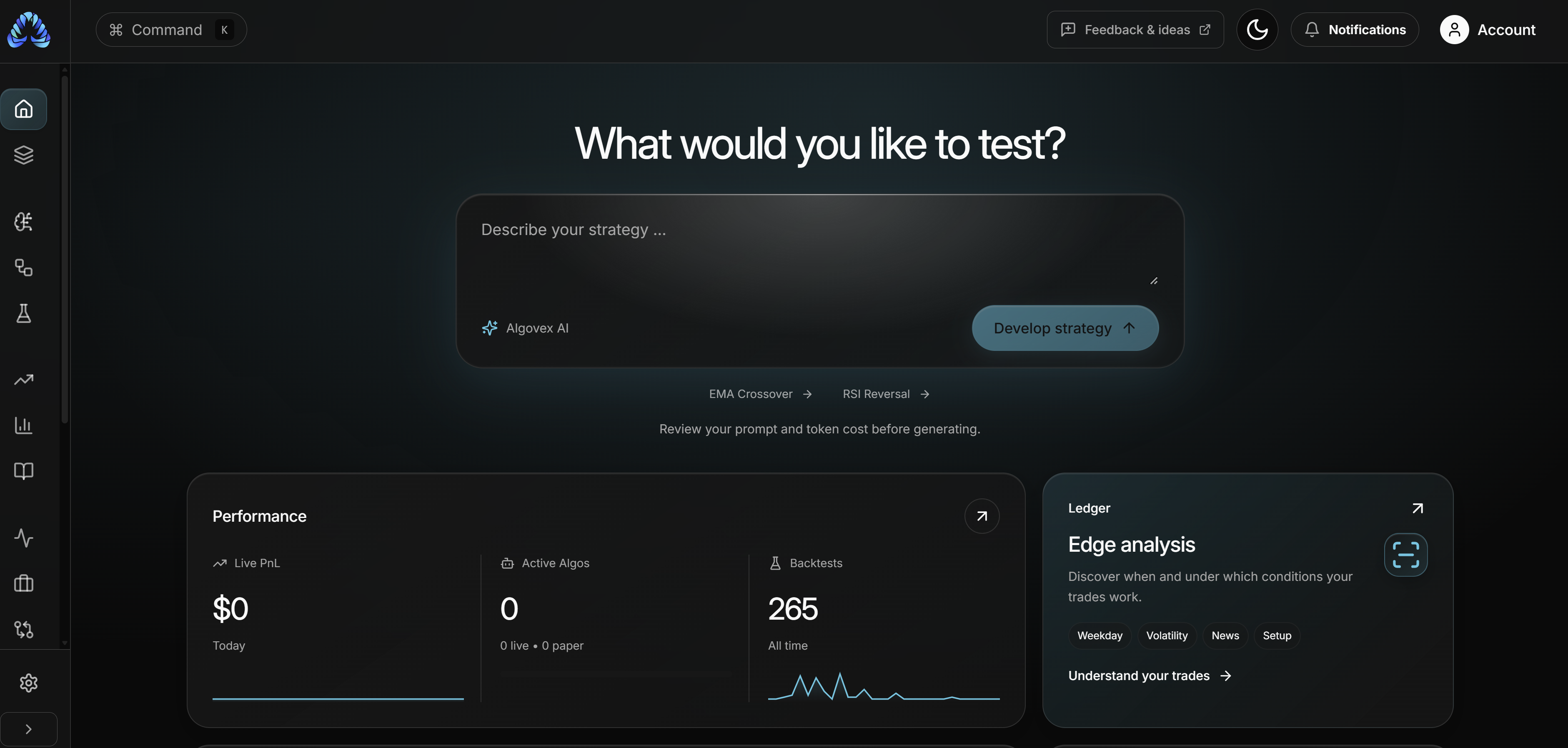
Algovex AI introduces a faster starting point: simply describe what you want to build.
Instead of manually assembling every part of a strategy, you can explain your trading idea in natural language and let Algovex AI generate the underlying strategy structure.
You can then inspect the result, make adjustments, and test it against historical market data.
How Algovex AI Works
The process starts with a description of your trading strategy.
You don't need to know programming syntax or understand how to structure an algorithm in code.
You do, however, need to communicate what you want the strategy to do.
For example, imagine you want to investigate whether pullbacks in established trends offer favorable trading opportunities.
You could describe your strategy like this:
"Build a long strategy that only trades when price is above the 200 EMA. Enter when price pulls back to the 20 EMA and closes back above it. Use a stop loss of 1.5 ATR and a take profit at twice the initial risk."
This description contains several important components.
The 200 EMA establishes the trend condition. The 20 EMA defines the pullback setup. ATR determines the stop distance, and the risk multiple defines the profit target.
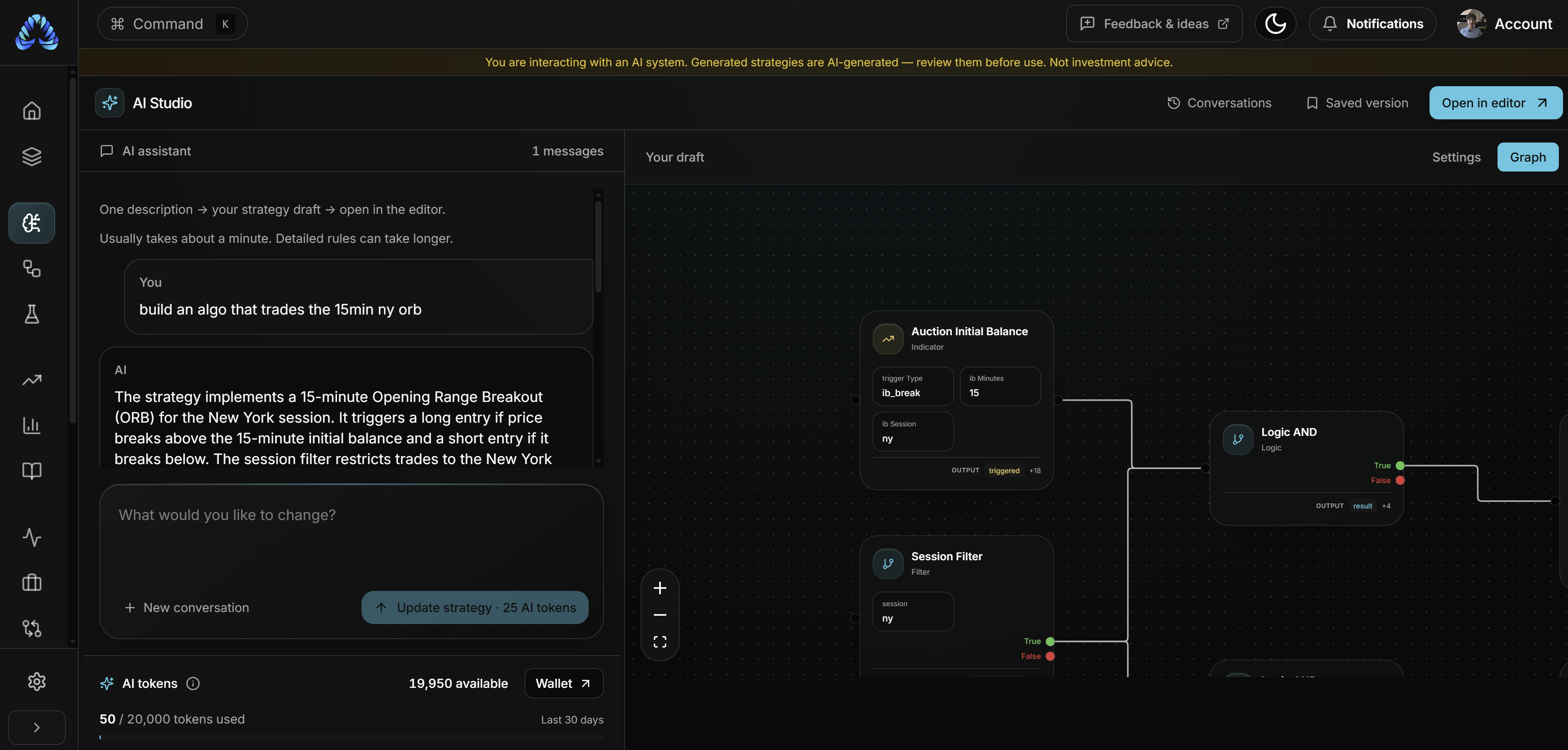
Algovex AI translates the description into a structured strategy using the platform's supported building blocks.
Rather than producing an opaque trading signal, the resulting strategy can be examined and modified through the visual editor.
This distinction is important.
AI can accelerate the construction of a strategy, but the resulting trading logic still needs to be understood and evaluated.
Building More Complex Strategies
Natural language strategy creation isn't limited to moving average systems.
Consider a different hypothesis involving market structure.
You might want to investigate whether price tends to reverse after sweeping the previous day's low during a particular trading session.
A description could specify that price must first trade below the previous day's low, subsequently close back above it, and then satisfy a defined confirmation condition before entering.
Alternatively, you might want to test a volatility breakout strategy that combines an ATR expansion filter with a breakout above a previous price range.
These strategies involve different types of market information, but the underlying process is similar.
You describe the conditions, the system constructs the supported trading logic, and you review the resulting strategy before testing it.
The accuracy of the generated result depends on how precisely the trading idea is described and whether the necessary operations are supported.
Ambiguous concepts may require clarification or manual adjustments.
AI Generated Doesn't Mean Uneditable
One of the most important aspects of Algovex AI is that the generated strategy remains editable.
This matters because developing a trading system rarely ends with the first version.
You might discover that an entry condition needs to be more restrictive. You might want to introduce a volatility filter, change a stop loss calculation, or investigate how a strategy behaves on another timeframe.
With Algovex, the generated strategy can be inspected and adjusted in the visual builder.
You aren't restricted to accepting the first result.
For example, suppose an AI generated breakout strategy performs poorly during low volatility periods.
You could investigate whether adding a relative volume filter changes its historical behavior.
Or you might discover that a mean reversion strategy performs differently depending on the direction of the higher timeframe trend.
These observations can become the basis for additional experiments.
The AI helps with the initial construction. The trader remains responsible for understanding the rules, evaluating the results, and deciding what to test next.
From AI Generated Strategy to Historical Backtest
Creating an algorithm is only the beginning.
A strategy that sounds logical isn't necessarily profitable, and a strategy that looks convincing on a chart may behave very differently across a larger historical sample.
That's why Algovex AI is integrated into a platform built around systematic strategy testing.
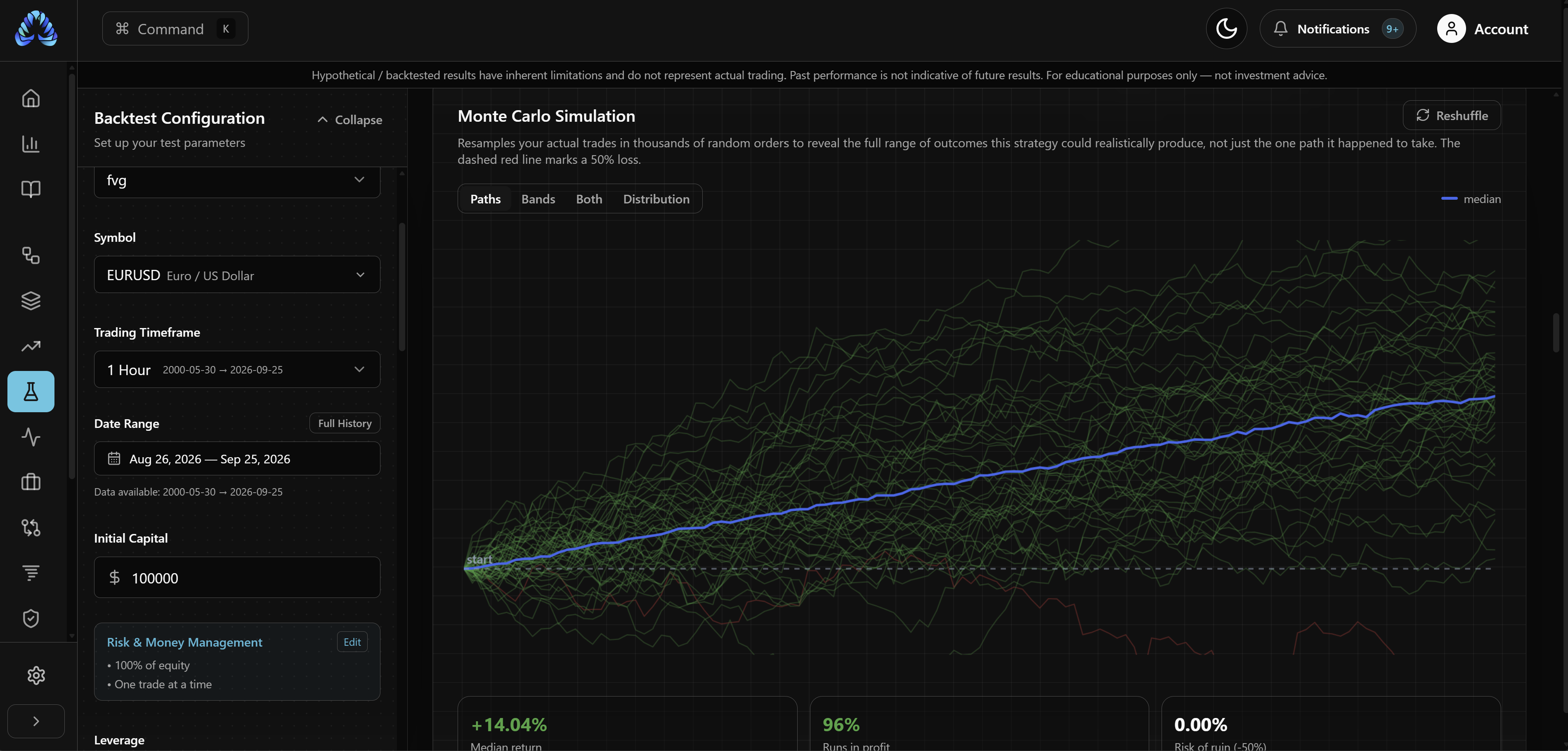
Once a strategy has been generated, you can evaluate it using Algovex's historical backtesting capabilities.
Depending on the instrument and available data, Algovex supports backtesting with up to 25 years of historical market data.
This allows you to investigate how the strategy would have behaved across different periods and market environments.
You can examine simulated trades, review entries and exits directly on the chart, and analyze performance statistics such as profit factor, drawdown, win rate, and risk adjusted returns.
However, these results need to be interpreted carefully.
Historical profitability does not establish that a strategy has a repeatable advantage.
Trading costs, data quality, execution assumptions, and the way the strategy was developed all influence the outcome.
Why Strategy Validation Still Matters
AI makes it easier to create trading strategies, but it also makes it easier to generate many variations.
That creates an important statistical challenge.
If you repeatedly modify a strategy until its historical results look impressive, you increase the risk of overfitting.
For example, you might generate a strategy, change several parameters, add filters, and continue testing until you find a particularly attractive equity curve.
But the best historical result may reflect random patterns in the data rather than a reliable trading advantage.
A more disciplined approach involves evaluating strategies on data that wasn't used during development and examining whether performance remains reasonably stable under different assumptions.
Algovex includes Walk Forward Optimization to investigate strategy behavior across successive optimization and evaluation periods.
Portfolio Backtesting, Black Swan Backtesting, and Prop Firm Simulation provide additional ways to evaluate strategies under different conditions and constraints.
These methods don't guarantee future profitability. They help traders understand the limitations and risks of their strategies.
Why We Built Algovex AI
When we started building Algovex, the goal was to make algorithmic trading more accessible.
The visual strategy builders were an important part of that.
Instead of writing code, users could construct strategies through a structured interface or a graph of connected building blocks.
But even without programming, translating a complicated trading idea into an algorithm can take time.
You need to identify the necessary indicators, structure the conditions, connect the logic, and verify that everything behaves as intended.
AI offers a way to simplify that process.
Rather than replacing the visual editor, we wanted to make it easier to get started.
Describe your idea, generate the strategy, inspect the logic, and test it.
The aim isn't to remove the research process.
It's to reduce the technical work required before that research can begin.
Can AI Build a Profitable Trading Strategy?
AI can help translate a trading idea into executable rules.
That doesn't mean it can guarantee a profitable strategy.
An algorithm can be implemented correctly and still lose money.
Similarly, an impressive historical backtest can be the result of overfitting, unrealistic execution assumptions, or favorable market conditions that may not continue.
AI generated strategies should therefore be treated as research starting points rather than trading recommendations.
It's important to inspect the generated logic, verify that it matches your intended rules, and evaluate it using appropriate historical and forward testing methods.
The ability to generate a strategy quickly is useful.
Understanding whether that strategy has a meaningful advantage remains the difficult part.
Algovex AI Is Available Now
Algovex AI is now available as part of the Algovex platform.
You can try the new AI strategy creation experience for free, with additional capabilities available through Algovex Pro.
We're excited to see how traders use the new workflow, which strategies they experiment with, and how the platform evolves from here.
Whether you're exploring a trading idea for the first time or building more sophisticated rule based systems, Algovex AI gives you another way to move from an idea to a testable algorithm.
Trading financial instruments involves risk. Historical and simulated results do not guarantee future performance. Algovex provides strategy development and testing tools, not guaranteed profitable trading systems or personalized investment advice.