Introducing Algovex MCP: Build and Backtest Trading Strategies With ChatGPT & Claude
Introducing Algovex MCP: Build and Backtest Trading Strategies With ChatGPT & Claude
Your AI assistant can now work directly with Algovex.
Today, we're introducing Algovex MCP, a new integration that connects AI assistants like ChatGPT and Claude to the Algovex algorithmic trading platform.
Instead of manually building every strategy, configuring every backtest, and analyzing every result yourself, you can now describe what you want to investigate in natural language.
Your AI assistant can help build trading strategies, run historical backtests, and analyze the results using the actual Algovex engine.
No coding required. No AI-generated performance estimates.
Just your trading ideas, your AI assistant, and real historical market data.
What Is Algovex MCP?
MCP stands for Model Context Protocol, an open standard that allows AI assistants to connect with external applications, tools, and data sources.
Normally, ChatGPT or Claude can explain trading concepts, suggest strategy ideas, and help you write code.
But without a connection to a trading platform, they can't independently execute a backtest using Algovex's historical data and strategy engine.
Algovex MCP changes that.
By connecting your AI assistant to Algovex, you give it access to supported strategy development, backtesting, and research tools.
Instead of simply discussing a strategy, your assistant can help you actually build and test it.
And because the integration uses the existing Algovex infrastructure, the results come from the same backtesting engine used throughout the platform.
Build Trading Strategies by Simply Describing Them
Every trading strategy starts with an idea.
Maybe you want to test a moving average crossover with a volatility filter. Maybe you're interested in breakout strategies during specific market sessions. Or perhaps you want to investigate whether an additional trend filter improves an existing strategy.
Traditionally, translating those ideas into algorithms requires programming knowledge or manually configuring a visual strategy builder.
With Algovex MCP, you can start with a natural language description.
For example, you could tell ChatGPT or Claude:
"Build a strategy that enters long when the 20 EMA crosses above the 50 EMA, but only when RSI is below 70. Use an ATR-based stop loss and a take profit at twice the initial risk. Then backtest it on EUR/USD using the 1-hour timeframe."
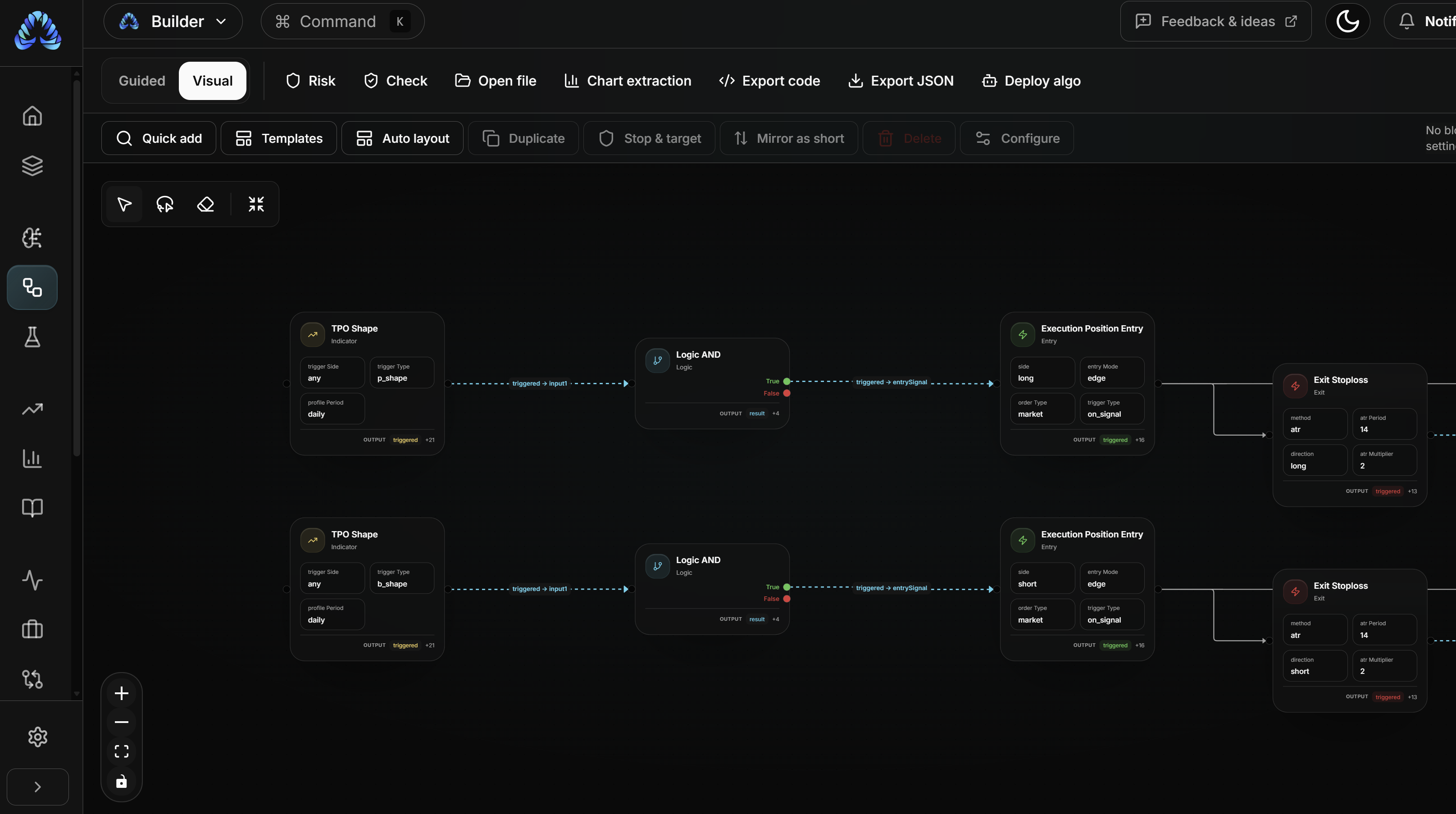
Your AI assistant can inspect the available Algovex building blocks, construct the strategy using supported components, and request a historical backtest.
You can then review the generated logic, make adjustments, and continue developing the strategy.
The important difference is that the AI isn't generating an imaginary trading system or estimating how it might perform.
It's working with the actual Algovex platform.
The generated strategy still needs to be reviewed to ensure its rules match your intended setup, and unsupported or ambiguous conditions may require adjustments.
Run Real Historical Backtests Through ChatGPT or Claude
Creating a trading strategy is only the first step.
The next question is whether the idea has demonstrated any historical advantage.
With Algovex MCP, your AI assistant can request backtests using the platform's historical market data.
You can specify the instrument, timeframe, testing period, and relevant execution assumptions.
Algovex then processes the strategy using its existing backtesting engine.
Once the calculation is complete, your assistant can retrieve the actual results and help you understand them.
This includes performance statistics and historical simulated trades.
For example, you could ask:
"Backtest this strategy over the last five years and analyze its profitability, maximum drawdown, Sharpe ratio, and trade distribution."
Or:
"Show me how this strategy performed during different market conditions and identify periods of significant drawdown."
The AI assistant can help organize and interpret the results, while the underlying calculations are performed by Algovex.
Why This Matters
A general-purpose AI model can explain why a trading strategy might work.
But an explanation isn't evidence.
Without executing a historical test, an AI model cannot reliably determine how a strategy would have performed.
Algovex MCP bridges that gap by connecting natural language interaction with actual quantitative analysis.
The AI helps you research. Algovex runs the calculations.
Historical backtests still have limitations. Results depend on the data, strategy logic, execution assumptions, and selected testing period. Past performance does not guarantee future results.
Go Beyond Basic Backtesting
Algovex MCP isn't limited to generating strategies and running individual backtests.
It also connects AI-assisted workflows with more advanced research capabilities available in Algovex.
Walk Forward Optimization
A strategy can perform exceptionally well on historical data and still fail when market conditions change.
One common reason is overfitting: adjusting a strategy too closely to the historical data used during development.
Walk Forward Optimization helps investigate this problem by repeatedly optimizing parameters on one historical period and evaluating them on a subsequent period.
Through supported Algovex MCP operations, your AI assistant can help configure these analyses and interpret the results.
This provides another perspective on how stable a strategy's parameters may be over time.
Portfolio Backtesting
A profitable individual strategy doesn't necessarily improve an overall trading portfolio.
Two strategies might perform well separately but experience their largest losses at the same time.
Portfolio analysis allows traders to investigate the combined historical behavior of multiple strategies.
With Algovex MCP, an AI assistant can help organize supported portfolio research workflows and examine their results.
Prop Firm Simulation
Strategies intended for proprietary trading environments often need to satisfy specific account restrictions.
A strategy might generate positive historical returns but still violate a simulated maximum drawdown rule or other evaluation requirement.
Algovex includes Prop Firm Simulation tools for analyzing strategies under supported rule sets.
These capabilities can also be accessed through supported MCP workflows.
Advanced Strategy Analytics
Understanding a strategy requires more than looking at its total return.
Maximum drawdown, risk-adjusted performance, trade distribution, and sensitivity to execution costs can all influence how a strategy should be evaluated.
Algovex provides additional analytics and research tools that help traders investigate these factors.
By connecting an AI assistant, you can explore supported analyses conversationally instead of manually navigating every step.
Work With Your Existing Algovex Strategies
You don't have to start from scratch.
Algovex MCP can also work with strategies you've already created and saved in the platform.
For example, imagine you've built a mean reversion strategy using RSI and Bollinger Bands.
You might want to investigate whether adding a higher-timeframe trend filter changes its historical performance.
Instead of rebuilding the entire strategy, you can ask your AI assistant to inspect the existing rules and help make the necessary modifications.
The updated strategy can then be evaluated using the same backtesting engine.
And because the underlying strategy uses Algovex's native building blocks, you can continue inspecting and editing it in the visual strategy editor.
AI-assisted development and manual strategy building can work together.
Why We Chose MCP Instead of a Traditional AI Strategy Generator
When we started building Algovex, our goal was to make algorithmic trading accessible without requiring users to write code.
The Simple Builder and Advanced Graph were designed around that idea.
But even with visual tools, translating a complicated trading idea into an algorithm can take time.
AI offers an opportunity to simplify that process.
One approach would have been to build a dedicated AI chatbot directly into Algovex.
Instead, we chose MCP.
Rather than limiting AI-assisted strategy development to a single interface, MCP allows compatible AI assistants to interact with the platform's existing tools.
This means you can work with an assistant such as ChatGPT or Claude while Algovex handles the actual strategy compilation, historical testing, and quantitative calculations.
It also allows the research process to become more conversational.
You can describe an idea, inspect the generated rules, request a backtest, review the results, and discuss possible improvements within the same workflow.
The objective isn't to replace the existing Algovex interface.
It's to give traders another way to use the platform.
AI Makes Research Faster, but Validation Still Matters
AI-assisted strategy development introduces an important challenge.
When it becomes easier to build and test strategies, it also becomes easier to test too many variations.
Imagine asking your assistant to try dozens of different indicator settings, entry filters, and stop-loss configurations.
Eventually, one combination might produce an impressive historical equity curve.
But that doesn't necessarily mean you've discovered a reliable trading advantage.
The result could simply be the best-performing variation among many unsuccessful experiments.
This is one reason why overfitting and selection bias are major concerns in quantitative trading research.
A disciplined approach should consider out-of-sample testing, realistic trading costs, parameter stability, and the number of variations tested.
Tools such as Walk Forward Optimization can help investigate some of these risks, but no single metric or testing method guarantees future profitability.
AI can accelerate strategy development. It cannot replace sound research methodology.
How to Connect Algovex to ChatGPT or Claude
Getting started with Algovex MCP involves connecting your Algovex account to a compatible AI assistant.
Sign in to your Algovex account.
Open your integration settings.
Follow the MCP connection instructions for your preferred AI assistant.
Authorize the connection and review the available permissions.
Start a conversation and describe the trading strategy or research task you want to perform.
Once connected, you can begin with something simple, such as asking your assistant to inspect an existing strategy or help create a new one.
For your first backtest, try to describe your entry rules, exit conditions, instrument, timeframe, and risk management as clearly as possible.
Review the generated strategy before testing it, and examine the actual results rather than relying exclusively on the assistant's interpretation.
Available operations may vary depending on the connected account, assistant, and platform permissions.
The Next Step for AI-Powered Algorithmic Trading
Algovex was built to make systematic trading research more accessible.
With our visual strategy builders, traders can develop algorithms without writing code.
With Algovex MCP, they can now take that process further.
Describe a strategy to ChatGPT or Claude. Build it with Algovex. Run a real backtest. Analyze the results.
All through a connected AI assistant.
This isn't about promising that AI will discover profitable strategies automatically.
It's about making the tools for developing and evaluating trading ideas easier to use.
And we're just getting started.
Algovex MCP is now available.
Connect Your AI Assistant to Algovex
Disclaimer: Trading financial instruments involves risk. Historical and simulated results do not guarantee future performance. Algovex provides strategy development and research tools, not personalized investment advice or guaranteed trading outcomes.