Free tool · No signup
Cost & Slippage Edge-Eater
The prettiest backtest is run with zero costs. Add real spread, fees and slippage and watch the edge shrink, sometimes to nothing. See how much your costs really take.
Slippage and fees are the real costs charged on every single trade. They quietly eat into the edge a zero-cost backtest shows, and for a high-frequency strategy with a thin edge they can shrink it all the way to nothing.
How it works
Set your edge and your cost per trade in R (spread, fees and slippage together), then Calculate. The tool subtracts that cost from every trade and shows how much of your edge survives, plus the cost level where it hits zero.
Your strategy & costs
The gap between backtest and reality
Costs are charged on every single trade, so the more you trade, the more they compound against you. A strategy with a thin edge and high frequency can look brilliant on paper and lose money live purely from spread and slippage. Always subtract realistic costs before you trust an edge, the red line marks the cost level where your edge hits zero.
Frequently asked
What counts as cost per trade?
Spread, commissions and slippage combined, expressed as a fraction of the amount you risk per trade in R.
Why do costs hurt high-frequency strategies most?
Because the cost is charged on every trade. The more you trade, the more it compounds against a thin edge.
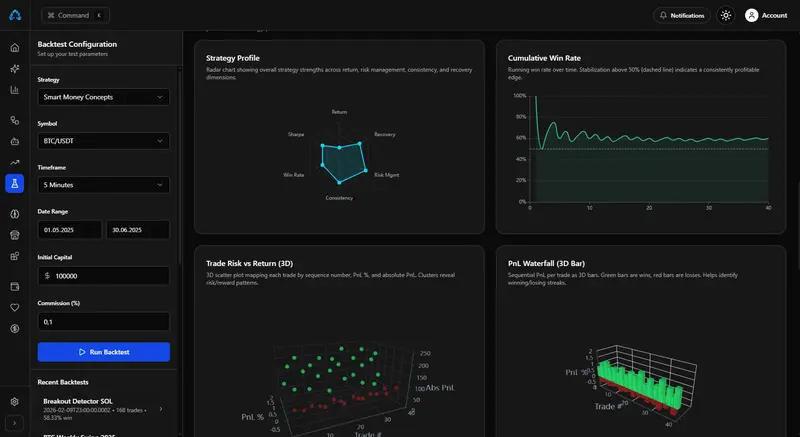
Backtest with real costs baked in, not a zero-fee fantasy. Build and test your strategy, no code.
Join the waitlist